Olympus OM 35mm film system close-up and macro equipment
Stage glasses, plates and accessories
Introduction
Five stage glasses or plates were available for the Macrophoto Stand VST-1. Some of these were also available for Olympus stereo microscopes, and some of the accessories for the stereo microscopes can be used with the VST-1. The glasses and plates are nominally 100 mm in diameter, and fit into the recess in the base of the Stand. There are grooves on either side of the recess to aid in removing the stage plates. The stage plates can be clamped in place by tightening the screw at the front of the base of the Stand. On some stereo microscopes, the plates are fastened in place with a holder spring instead of a screw.
One of the stage plates can be fitted with a mechanical stage for precise movements of small objects. A cup stage can be used to tilt the stage plates so as to move a three-dimensional object into the best position for viewing or for photography.
Frosted Stage Glass SP-BW-2
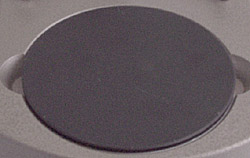
This is the stage glass that is supplied with the VST-1 Stand and the Cup Stage SZH-SC. It is opaque (so can only be used with incident lighting), made of plastic, and reversible. One side is matt black, for use with light subjects, and the other side is glossy white, for use with dark subjects. It was part of the PMT-35 Manual Photomacrographic System. The same stage glass has been supplied with several Olympus stereo microscopes.
| Diameter | 99.9 mm |
|---|---|
| Thickness | 5.7 mm |
| Weight | 56 / 64 gm |
| Microscope ref. | SP-BW-2 |
| Olympus no. | S-0757 |
| US stock no. | 104-131 |
| Introduced | 1972 |
| Discontinued | 2003* |
| 1978 US price | $10.50 |
| 1988 US price | $22.00 |
| 1979 UK price | £5.90 |
* Still available for stereo microscopes
 |
 |
|
| Olympus OM Frosted Stage Glass (black surface) |
Olympus OM Frosted Stage Glass (white surface) |
The stage glass is not marked “Olympus”.
Versions
Only one version is known.
Alternatives
Chinese eBay sellers often list alternative 100 mm black/white stage plates with various thicknesses.
Instruction leaflet
Instructions were not provided with this item.
Clear Stage Glass SP-C
This stage glass is made of transparent glass with a slight green tinge, and fits into the recess in the base of the VST-1 Stand. It can be used for either incident or transmitted lighting. It was part of the PMT-35 Manual Photomacrographic System. The same stage glass was supplied with the SZ-ILA Trans-Illuminator Base for the Olympus SZ4045 and similar stereo microscopes, and with more recent transmitted-light bases.
| Diameter | 99.5 mm |
|---|---|
| Thickness | 5.7 mm |
| Weight | 111 gm |
| Microscope ref. | SP-C |
| Olympus no. | S-0750 |
| US stock no. | 104-130 |
| Introduced | 1972 |
| Discontinued | 2003* |
| 1978 US price | $10.50 |
| 1988 US price | $22.00 |
* Still available for stereo microscopes

Olympus OM Clear Stage Glass
The stage glass is not marked “Olympus”.
Versions
Only one version is known.
Alternatives
Chinese eBay sellers often list alternative 100 mm glass stage plates with various thicknesses.
Instruction leaflet
Instructions were not provided with this item.
Stage Plate 28
This stage plate is made of metal, with a matt black finish, and has a central aperture 28 mm in diameter. It is 120 mm in diameter, and has a ring on its lower surface which fits into the aperture in the base of the Macrophoto Stand. It can be used for transmitted or reflected light. It was part of the PMT-35 Manual Photomacrographic System. Near the outer edge there is a threaded hole and 2 guide holes for attaching the Mechanical Stage FM-II or the Mechanical Stage FM-III.
| Diameter | 120 mm |
|---|---|
| Diameter of lower rim | 99.9 mm |
| Diameter of central aperture | 28.0 mm |
| Thickness | 11.2 mm (outer rim) 5.0 mm (main area) |
| Weight | 129 gm |
| US stock no. | 104-132 |
| Introduced | 1972 |
| Discontinued | |
| 1978 US price | $21.00 |
| 1988 US price | $40.00 |
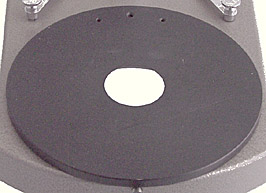
Olympus OM Stage Plate 28
The stage plate is not marked “Olympus”.
Versions
Only one version is known.
Instruction leaflet
Instructions were not provided with this item.
Stage Plate 45
This stage plate is made of metal, with a matt black finish, and has a central aperture 45 mm in diameter. It fits into the recess in the base of the VST-1 Stand. It can be used for transmitted or reflected light. It was part of the PMT-35 Manual Photomacrographic System.
| Diameter | 99.9 mm |
|---|---|
| Diameter of central aperture | 45.0 mm |
| Thickness | 6.1 mm (outer rim) 2.9 mm (main area) |
| Weight | 58 gm |
| US stock no. | 104-133 |
| Introduced | 1972 |
| Discontinued | 2002 |
| 1978 US price | $16.00 |
| 1988 US price | $40.00 |
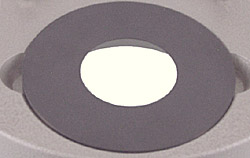
Olympus OM Stage Plate 45
The stage plate is not marked “Olympus”.
Versions
Only one version is known.
Instruction leaflet
Instructions were not provided with this item.
Shade Stage Plate PM-LM-SP
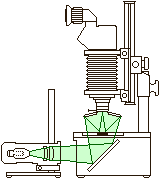
This colourless, transparent plastic plate fits into the recess in the base of the VST-1 Stand, and is designed for use with the Lieberkühn Reflectors, Trans-Illuminator Base (with the Centering Mirror fitted) and the Trans-Illuminator, for soft, shadowless lighting.
It comes with 2 Shutter Interrupter Plates, 24.5 mm diameter, one black (for light subjects) and the other glossy white (for dark subjects), which fit into a recess in the centre of the plate.
Light from the Trans-Illuminator is reflected by the Centering Mirror in the Trans-Illuminator Base, passes upwards through the transparent area of the plate, and is then reflected down by the Lieberkühn reflector, onto the subject, which rests on one of the opaque interrupter plates in the centre of the plate.
|
|
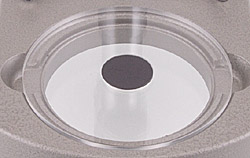 |
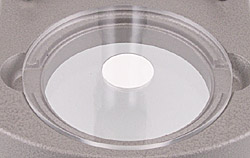 |
|
| Olympus OM Shade Stage Plate (black insert) |
Olympus OM Shade Stage Plate (white insert) |
The stage plate is not marked “Olympus”.
Versions
Only one version is known.
Instruction leaflet
Instructions were not provided with this item.
Polarizing Filter SZ-PO-P
Brochures for the original M-1 system include the Polarizing Filter SZ-PO-P and the Analyzing Filters PM-POL 20 (for the Zuiko Macro 20 mm f/3.5), PM-POL 38 (for the Zuiko Macro 38 mm f/3.5) and PM-POL 80 (for the Zuiko 1:1 Macro 80 mm f/4 and the Zuiko Auto-Macro 50 mm f/3.5), which would have been used for transmitted polarised light. They are not included in any later literature, and it is not known if they were produced for sale. The system chart shows the SZ-PO-P fitting the base of the VST-1 stand, like a stage plate.
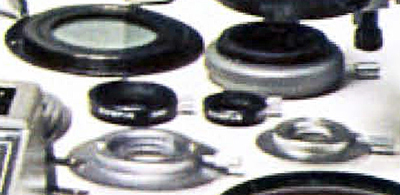
SZ-PO-P Polarizing Filter and three PM-POL Analyzing Filters (and two Lieberkühn reflectors)
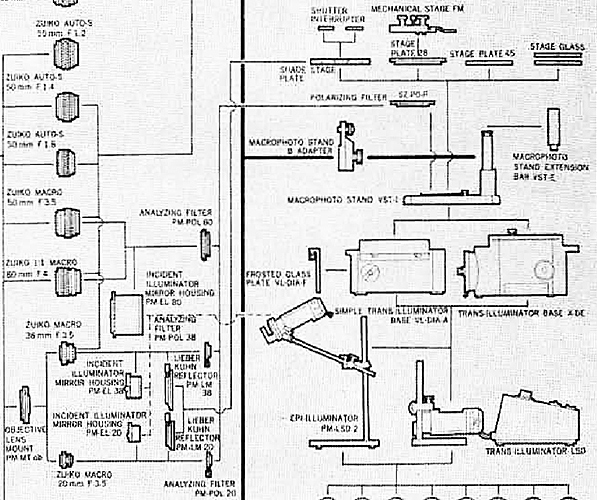
Olympus M-1 system chart with SZ-PO-P Polarizing Filter and three PM-POL Analyzing Filters
A brochure for the SZ-III Zoom-Stereo Microscope illustrates the very similar SZ-PO polarizing attachment. The polarizer appears to be the same diameter as the stage plates and identical to the SZ-PO-P. The analyzer would only have needed the thread changed from 48 mm to 49 mm to adapt it to the 50 mm f/3.5 and 80 mm macro lenses.
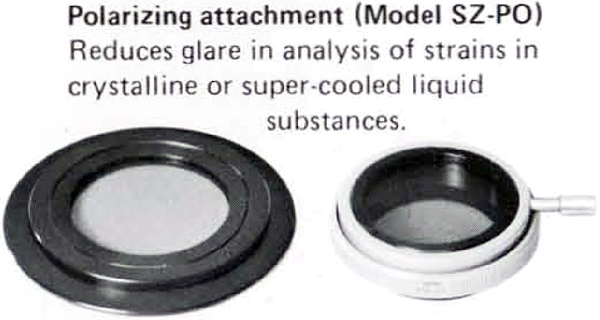
SZ-PO Polarizing Attachment
Cup Stage SZH-SC
The plastic base of the Cup Stage fits into the base of the Macrophoto Stand VST-1. The metal top part of the Stage has a circular recess to take one of the stage plates, and holes for the stage clips.
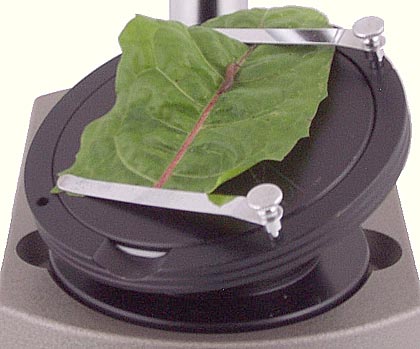
Olympus Cup Stage
The lower part has a circular depression into which the top part fits. The top part is quite heavy, and its lower surface is hemispherical. This combination allows the top part to be rotated and tilted, and to remain in place by friction.
It is supplied with a Frosted Stage Glass SP-BW-2 and a pair of stage clips for holding thin specimens. For clamping a thicker object such as a Petri dish, soft plastic tubes are provided that can be slipped onto the stage clips.
It is not possible to use the Stage Plate 28 and one of the mechanical stages, because the combination is too heavy and the cup stage tilts.
The Cup Stage is not mentioned in any of the Olympus literature on the OM macro equipment. It is considered to be an accessory for the Olympus stereo microscopes, but it can be very useful for getting a three-dimensional subject into the best position for viewing or to be photographed.
The bottom of the base is marked “Olympus” (with a serial number), the top part is not marked “Olympus”.
Instructions
Send comments or questions to Alan Wood

Created 18th May 2001 — Updated 6th May 2026
Copyright © 2001–2026 Alan Wood