Olympus microscopes and photomicrographic equipment
Attaching a digital SLR camera to an Olympus BH, CH or IMT microscope
Introduction
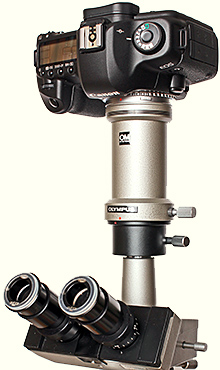
Olympus produced equipment for connecting their Olympus OM 35 mm film cameras to trinocular versions of their BH (BHA, BHB and BHC biological models, BHF fluorescence model and BHM and BHMJ metallurgical models) and CH compound microscopes and IMT inverted microscope for photomicrography. These accessories can either be adapted or replaced to allow Canon EOS, Four Thirds, Nikon, Pentax, Sigma, Sony and other digital SLR cameras to be used instead of OM cameras, with the digital sensor located in exactly the same plane as the film.
Starting from the top, you need the following 6 items:
The BH microscopes were discontinued around 1980, and so most of the items referred to on this page (including the Photomicro Adapter L, the FK photo eyepieces, the PM-ADF eyepiece adapter and the BH-TR30 and BH-TR45 trinocular heads) have also been discontinued. The best places to find them are eBay and microscope dealers who sell used equipment.
Remote control software makes photomicrography much easier. Instead of peering through the viewfinder or using the small LED screen on the camera, you can use your computer to check focus, compose, set white balance, adjust exposure and take the photograph. Focus stacking software increases depth of field, which often makes photographs appear sharper.
Camera bodies
You do not need a lens on the camera, because the photo eyepiece is designed to project an image directly onto the sensor. The best digital SLRs to use as replacements for an Olympus OM have a 36×24 mm full-frame sensor, for example the Canon EOS 5D Mark II, 5D Mark III and 6D, allowing you to carry on using the same FK 2.5× photo eyepiece.
A cheaper option is a digital SLR with an APS-C sensor (22.2×14.8 mm), such as the Canon EOS 7D, 40D, 50D, 600D (Rebel T3i) and 1100D (Rebel T3), but the smaller sensor results in a substantially smaller field of view.
It is possible to use digital cameras with a Four Thirds sensor (17.3×13.0 mm), but the camera’s field of view is even smaller than with an APS-C sensor.
Vibration from the camera’s mirror and shutter can be a problem when taking photographs through a microscope. Traditional solutions include electronic flash, long exposure times, mirror pre-release, and stands that support the camera independently of the microscope.
Canon EOS digital cameras from the 5D Mark II, 7D, 40D, 450D and 1000D onwards have a Live View Silent Shooting mode that makes them particularly suitable for photomicrography. In this mode, vibration is almost eliminated, because the exposure is started electronically while the mirror is already raised and the shutter is already open. This is also referred to as EFSC or electronic first shutter curtain. EOS cameras also come with EOS Utility software that allows the camera to be controlled via a USB connection from a computer, allows the computer screen to be used for checking focus and composition, and allows images to be saved directly to the computer.
The camera body is connected via a lens adapter to the camera adapter.
Lens adapters
The lens adapter connects the camera body to the camera adapter, and ensures that the digital sensor is located in exactly the same plane as the film in an OM camera.
For Canon EOS camera bodies, new lens adapters are readily available on eBay to enable these bodies to be fitted to the top of the Photomicro Adapter L instead of an Olympus OM camera. These adapters convert the OM bayonet on the Adapter L to an EF bayonet, and exactly compensate for the 2.0 mm difference in registration between OM and EOS bodies.
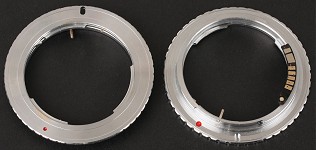
Front and rear of adapter for mounting an OM lens on a Canon EOS camera
There are 3 types of adapter for using Canon EOS bodies – no chip, AF confirm chip and EMF chip. The features of the 3 adapters are:
| no chip | AF confirm | EMF | |
|---|---|---|---|
| M (manual exposure, user sets the shutter speed) |  |
|
|
| Av (auto exposure, camera sets the shutter speed) | |
|
|
| Spot, partial, centre-weighted and evaluative metering | |
|
|
| Confirmation of manual focus by beeping and by flashing one or more of the AF points in the viewfinder |  |
|
|
| EXIF lens data fixed at 0 mm for focal length and F/0 for aperture | |
|
|
| EXIF lens data fixed, e.g. 50 mm for focal length and F/1.4 for aperture | |
|
|
| EXIF lens data can be changed by user | |
|
|
For Sony NEX, Four Thirds and Micro Four Thirds camera bodies, new lens adapters are readily available on eBay to enable these bodies to be fitted to the top of the Photomicro Adapter L instead of an Olympus OM camera.
For Minolta AF/Sony α camera bodies, there are new adapters on eBay that might be suitable for use with a Photomicro Adapter L. The adapters are thick but they include a lens, so they might allow OM lenses to focus to infinity; if this is the case, then they probably are suitable.
For Nikon F camera bodies, it is not possible to make an adapter, but it is possible to remove the OM mount from the Photomicro Adapter L and attach a Nikon F mount.
For Canon EOS, Minolta, Nikon, Olympus E, Panasonic, Pentax, Sigma, Sony α, Sony NEX and other camera bodies, new T-2 lens adapters are readily available on eBay to enable these bodies to be used with alternative camera adapters that have a T-2 fitting on top.
Camera adapters
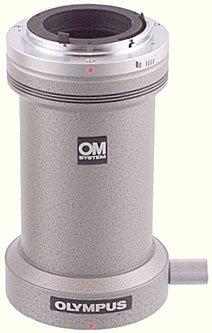
Olympus produced the Photomicro Adapter L to allow their Olympus OM 35 mm film cameras to be used for photomicrography with trinocular versions of their BH compound microscopes. Lens adapters are easily available on eBay to convert the OM rear lens fitting on the top of the Adapter L so that Canon EOS, Four Thirds and other shallow-bodied cameras can be used instead of OM cameras, with the digital sensor located in exactly the same plane as the film. It is not possible to make an adapter for Nikon F cameras, but the OM mount can be replaced with one for Nikon F cameras.
The bottom of the Adapter L clamps on to the circular dovetail on an eyepiece adapter.
The Adapter L was originally finished in grey to match the BH microscope. The finish was later changed to cream to match the BH-2 microscope.
Alternative camera adapters
If you want to use a Pentax or other deep-bodied digital SLR, it is not easy to convert the Adapter L, but there are at least 3 sources of alternative adapters that attach to the Olympus 38 mm circular dovetail at the bottom and take a T-2 mount at the top. I have not seen any of these adapters, so please contact the manufacturers to ensure that they are suitable.
1) Richard J. Kinch (Olympus 38mm Dovetail to T-mount Adapter) makes an adapter that maintains the proper 150.0 mm distance from the lip on which the top section of an NFK eyepiece rests to the plane of the sensor.
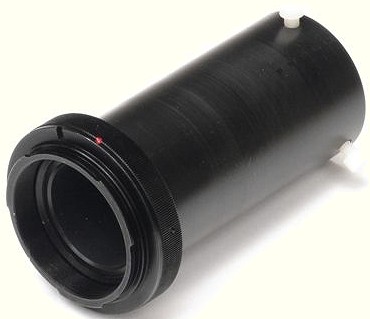
Richard J. Kinch’s adapter
2) Martin Microscopes produce their MBH2T adapter; this is not listed on their website so you need to contact Martin Microscopes.
3) Diagnostic Instruments used to produce their PA1-10A adapter.
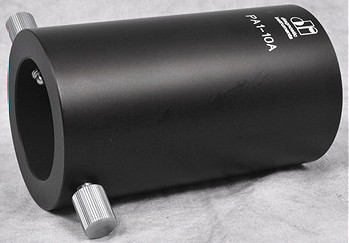
Diagnostic Instruments PA1-10A adapter
Photo eyepieces
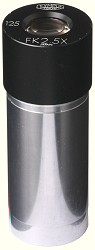
To project the image produced by the objective onto the sensor in the camera body, special photo eyepieces that sit inside the circular dovetail on the eyepiece adapter are used, not the viewing eyepieces.
The FK photo eyepieces were designed for photomicrography with the short barrel objectives that were supplied with the BH microscope, including the Plan, PlanApo, MPlan and Neo Plan ranges. These objectives have a 36.65 mm parfocal distance.
For digital SLRs with a full-frame sensor, such as the Canon EOS 5D Mark II and Mark III, the most appropriate photo eyepiece is the FK 2.5×.
For digital SLRs with an APS-C sensor, such as the Canon EOS 7D, 40D, 50D and 550D, the most appropriate photo eyepiece is also the FK 2.5×, but the field of view is substantially reduced because of the smaller sensor.
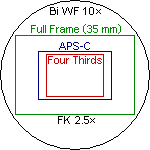
Camera image areas with Olympus FK 2.5× photo eyepiece, relative to Bi WF10× viewing eyepieces (F.N. 18)
For digital SLRs with a Four Thirds sensor, the most appropriate photo eyepiece is also the FK 2.5×, but the very small sensor means that the camera’s field of view is even smaller than with an APS-C sensor.
Olympus did not make an FK photo eyepiece with a lower magnification than 2.5× that would have compensated for sensors smaller than 35 mm film.
The FK 3.3×, 5× and 6.7× photo eyepieces can be used when higher magnification (with a correspondingly smaller field of view) is required.
Olympus did not make a photo eyepiece that can cover the field of view through the BH-SWTR superwide trinocular head.
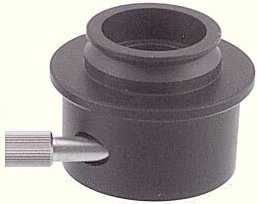
Eyepiece adapters
The trinocular heads for the BH, CH and IMT microscopes have a plain vertical eyepiece tube with a 25 mm external diameter.
They need the PM-ADF eyepiece adapter that clamps on to the vertical tube to provide the circular dovetail for attaching a camera adapter.
The FK photo eyepiece sits inside the circular dovetail.
Trinocular heads
Trinocular heads have a pair of inclined tubes for binocular viewing plus a third vertical tube that takes an FK photo eyepiece.
Four trinocular heads were made for the BH, CH and IMT microscopes. They all have a plain vertical eyepiece tube and need an eyepiece adapter in order to provide the circular dovetail for attaching a camera adapter. The common trinocular head is the BH-TR45, and there is also a BH-TR30, a strain-free BH-PTR30 and an uncommon and expensive superwide head, the BH-SWTR.
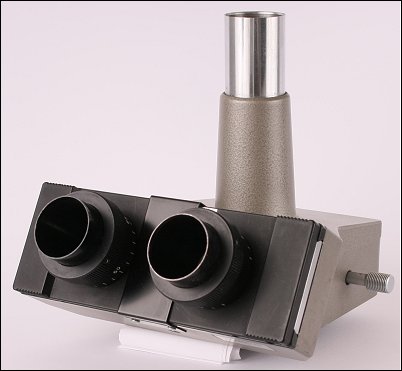
Olympus BH-TR30 trinocular head
On the BH-TR45, BH-TR30 and BH-PTR30 trinocular heads, both viewing eyepiece tubes are adjustable. To make the viewing eyepieces parfocal with the camera, first focus the image from a low-power objective seen through the camera. Then, without touching the microscope’s coarse or fine focus knobs, adjust the left and right viewing eyepiece tubes to bring the images seen through the eyepieces into focus.
On the BH-SWTR superwide trinocular head, both eyepiece tubes are fixed but the superwide eyepieces incorporate dioptric adjustment. To make the viewing eyepieces parfocal with the camera, first focus the image from a low-power objective seen through the camera. Then, without touching the microscope’s coarse or fine focus knobs, adjust the left and right viewing eyepieces to bring the images seen through the eyepieces into focus.
Trinocular heads for the BH-2 microscope can be used on the BH. They incorporate the circular dovetail and so the PM-ADF eyepiece adapter is not necessary.
Remote control software
To make the best use of a digital SLR, you need to abandon the way you worked with 35 mm film. Remote control software such as EOS Utility for Canon digital SLRs lets you connect the camera to the USB port of the computer. Then you can display the image from the camera’s sensor on your computer screen so that you can check focus, compose, adjust white balance and exposure, and take the photograph. Images are stored on your hard drive. There is no need to touch the camera except to turn it on and off.
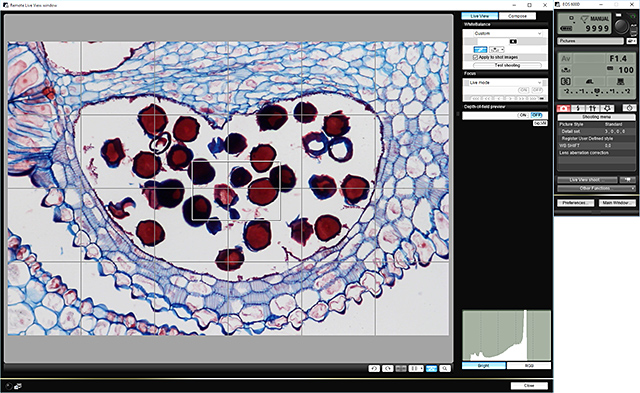
Canon EOS Utility software
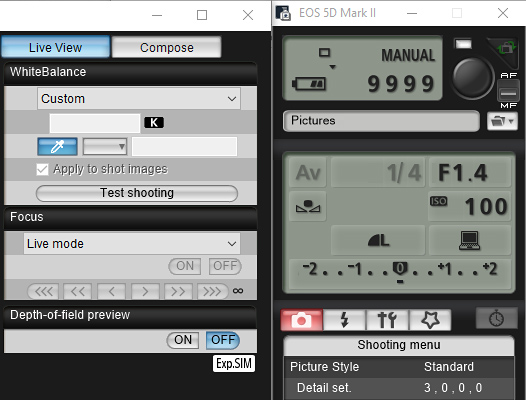
Camera and image controls in Canon EOS Utility software
Using the camera this way drains its batteries quite quickly, so it is a good idea to use a mains adapter.
Focus stacking software
A common problem when starting photomicrography is a perceived lack of sharpness in the photos, compared with the view through the binocular eyepieces. Often, the cause is not a fault with your equipment or technique, but shallow depth of field. The solution is to take a series of photos focused at different points, and then use focus stacking software that selects the sharpest parts of each image and combines them to produce an image with good depth of field.
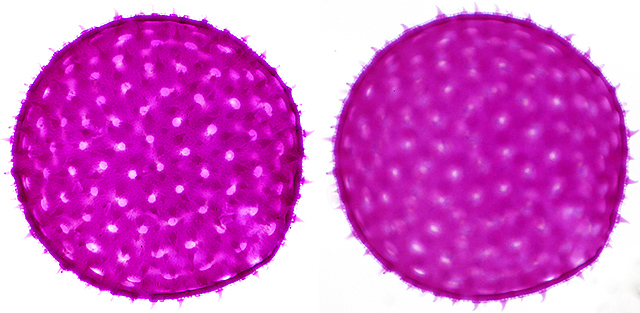
Mallow pollen grain, stack of 12 images (left) and single image (right)
The two most popular stacking programs are Zerene Stacker (the one that I use) and Helicon Focus.
Further reading
For more information, see the following pages:
- Photomicro Adapter L
- Photo eyepieces
- Eyepiece adapters
- Olympus BH microscope instructions and brochures
- Olympus CH microscope instructions and brochures
For information on how to use cameras with other Olympus microscopes, see the following pages:
- Attaching a digital SLR camera to an Olympus BH-2 microscope
- Attaching a C-mount video camera to an Olympus BH-2 microscope
- Attaching a digital SLR camera to an Olympus CH-2, CK2, CK40 or CK40M microscope
- Attaching a digital SLR camera to an Olympus BX, CX, CKX or IX microscope
- Attaching a digital SLR camera to an Olympus SZ4045, SZ4060, SZ6045 or SZ1145 stereo microscope
Send comments or questions to Alan Wood

Created 29th July 2011 — Updated 16th October 2019
Copyright © 2011–2019 Alan Wood