Olympus microscopes and photomicrographic equipment
Compound microscopes
During the time that the OM system was in production (1972–2003), Olympus produced four different ranges of compound microscopes. They could all be fitted with trinocular heads to make them convenient for photomicrography.
E and F microscopes
The first range included the E and F research microscopes, introduced in 1958 and 1960 respectively, which used objectives designed for a parfocal distance of 36.65 mm and a tube length of 160 mm, and for which the FK photo eyepieces are matched. The biological models included:
- EHT – separate coarse and fine focusing knobs, fine focusing graduated at 2 μm intervals, right-hand vertical controls for the mechanical stage, 6V 30W lamp (8-C101, TB-1)
- FHT – coaxial coarse and fine focusing knobs, fine focusing graduated at 1 μm intervals, left- and right-hand horizontal controls for the mechanical stage, 6V 30W lamp (8-C101, TB-1)
- Olympus information on the E microscope
- Olympus information on the F microscope
- Free PDFs of Olympus instructions and brochures for the E and F
AH (Vanox) and BH microscopes
The second range included the AH (Vanox) research microscope (introduced 1972), BH clinical microscope (introduced 1974) and CH student microscopes (introduced 1976), which used objectives designed for a parfocal distance of 36.65 mm and a tube length of 160 mm, and for which the FK photo eyepieces are matched. The biological models included:
- BHA – interchangeable nosepiece, 6V 30W lamp (8-C102, LS 30)
- BHB – fixed nosepiece, 6V 30W lamp (8-C102, LS 30)
- BHC – fixed nosepiece, 6V 15W lamp (8-C103, LS 15)
- IMT – inverted microscope, 6V 30W lamp (8-C102, LS 30)
- Olympus information on the AH microscope
- Olympus information on the BH microscope
- Olympus information on the CH microscope
- Attaching a digital SLR camera to an Olympus BH microscope
- Free PDFs of Olympus instructions and brochures for the Vanox
- Free PDFs of Olympus instructions and brochures for the BH
- Free PDFs of Olympus instructions and brochures for the CH
AH-2 (Vanox) and BH-2 microscopes
The third range included the AH-2 (Vanox) research microscope (introduced 1983), BH-2 clinical microscope (introduced 1980) and CH-2 student microscope (introduced 1985), which used objectives with a parfocal distance of 45 mm and a tube length of 160 mm, and for which the NFK photo eyepieces are matched. The biological models included:
- BHS – wide base, interchangeable nosepiece, 12V 100W lamp (8-C406)
- BHSU – wide base, fixed nosepiece, 12V 100W lamp (8-C406), cannot use B-AN analyser or BH-RLA reflected light attachment
- BHT – standard base, interchangeable nosepiece, 6V 20W lamp (8-C405)
- BHTU – standard base, fixed nosepiece, 6V 20W lamp (8-C405), cannot use B-AN analyser or BH-RLA reflected light attachment
- CK2 – inverted microscope, 6V 20W lamp (8-C405)
- CK40 – inverted microscope, 6V 30W lamp (8-C410)
- IMT-2 – inverted microscope, 12V 50W lamp (8-C407)
- Olympus information on the BH-2 microscope
- Olympus information on the AH-2 microscope
- Attaching a digital SLR camera to an Olympus BH-2 microscope
- Attaching a C-mount video camera to an Olympus BH-2 microscope
- Free PDFs of Olympus instructions and brochures for the Vanox
- Free PDFs of Olympus instructions and brochures for the BH-2
- Free PDFs of Olympus instructions and brochures for the CH-2
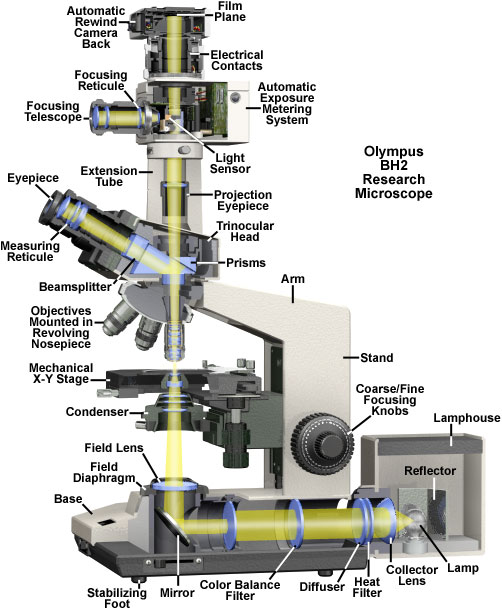
Olympus BH-2 BHS Research Microscope Cutaway Diagram – copyright Olympus America Inc.
BX and CX microscopes
The fourth range includes the current BX and CX models, which use infinity-corrected objectives, and for which the PE photo eyepieces are matched.
- Olympus information on the AX microscope
- Olympus information on the BX microscope
- Olympus information on the CX microscope
- Attaching a digital SLR camera to an Olympus BX or CX microscope
Manuals and instructions
With all microscopes, it is essential to adjust the eyepieces to match your eyesight and eye separation, and to adjust the condenser and other parts of the lighting system for optimum illumination for a particular objective. Manuals for some older Olympus microscopes can be downloaded on this site:
Instruction manuals for BX and other current Olympus microscopes and accessories can be downloaded from Olympus:
Brochures for BX and other current Olympus microscopes and accessories can be downloaded from Olympus:
Replacement bulbs and lamps
Searching Google or other search engines for the word “Olympus” and the bulb reference will find several suppliers, but they all seem to be in the USA.
The following companies in the United Kingdom can supply bulbs for old Olympus microscopes:
Screwdrivers
Many of the cross-head screws used in Olympus microscopes do not conform to the Phillips or Pozidriv standards that are common in Europe and North America, but to a Japanese Industrial Standard (JIS). Using a Phillips screwdriver on a tight JIS screw is likely to damage the head. The small 00 and 0 JIS screwdrivers are not easy to find in the UK, but sets containing sizes 1, 2 and 3 are available from several suppliers; search Google or Bing for:
jis screwdrivers uk
Allen screws are likely to be metric rather than Imperial.
Send comments or questions to Alan Wood

Created 8th April 2005 — Updated 12th February 2026
Copyright © 2005–2026 Alan Wood