Olympus microscopes and photomicrographic equipment
C-Mount adapters
Introduction
C-Mount adapters provide a way to attach video cameras to a compound or stereo microscope. Most Olympus compound microscopes can be fitted with a C-mount adapter.
MTV-3 C-Mount TV Adapter

Olympus produced the cream-coloured MTV-3 C-mount adapter (catalogue number 7-C555) to allow video cameras and 16 mm cine cameras to be used with trinocular versions of their BH-2 compound microscopes. The detachable top section has a male C-mount for attaching a camera and a 0.3× reducing relay lens that intercepts the image from the NFK photo eyepiece and relays it onto the sensor in the camera. The bottom of the MTV-3 clamps on to the 38 mm circular dovetail on trinocular heads of Olympus microscopes.
The MTV-3 produces a circular image approximately 16 mm in diameter, and to take full advantage of this a video camera with a 1″ sensor would be needed.
Reduction factors in C-mount adapters are normally quoted relative to a 1″ sensor, so a 0.3× adapter would be used with a 1/3″ sensor. However, in the specification of the MTV-3 (and the U-PMTVC), Olympus use 0.3× to refer to the reduction of the image circle of an NFK 2.5× eyepiece from approximately 48 mm (to safely cover 35 mm film) down to 16 mm for a 1″ video sensor.
U-PMTVC TV Adapter
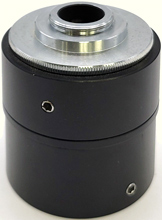
Olympus also produced the similar black U-PMTVC adapter (catalogue number U-V210, 037151) for the BX and other current Olympus microscopes, and this can also be used on the BH-2. Like the MTV-3, it includes a 0.3× reducing relay lens. The only significant difference from the MTV-3 is that it provides some adjustment for parfocality between the video camera and the viewing eyepieces.
- Focus through the viewing eyepieces.
- Loosen both Allen (hex) clamping screws on the U-PMTVC.
- Hold the top part stationary, and rotate the lower part until the image on the monitor is in focus.
- Re-tighten both clamping screws.
TVZ-M Zoom Video Lens
Olympus also produced the uncommon and expensive TVZ-M Zoom Video Lens (catalogue number 7-C567) with a magnification range of 0.55× to 1.1×. This includes a parfocalising collar and is designed to work without a separate photo eyepiece; it appears to have a built-in photo eyepiece. The bottom of the TVZ-M clamps on to the 38 mm circular dovetail on trinocular heads fof Olympus microscopes.
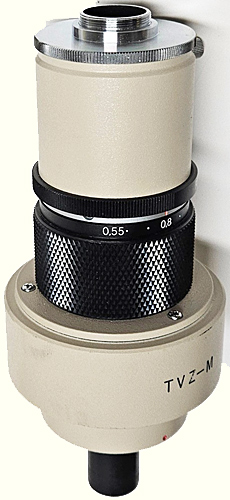
Olympus TVZ-M Zoom Video Lens
For more information, see:
Send comments or questions to Alan Wood

Created 25th November 2026 — Updated 25th November 2026
Copyright © 2026 Alan Wood