Olympus OM 35mm film system close-up and macro equipment
Close-up lenses
Introduction
Olympus included two single-element close-up lenses in the range of accessories for the OM cameras, one for lenses with a 49 mm filter thread and the other for lenses with a 55 mm filter thread. Both lenses were the same strength, +2.5 diopters.
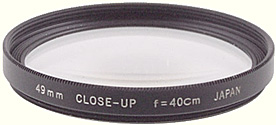 |
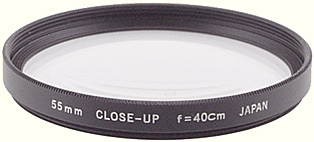 |
| Olympus OM 49 mm Close-Up Lens f=40cm | Olympus OM 55 mm Close-Up Lens f=40cm |
In addition to these general-purpose close-up lenses, Olympus also made the Close-up Lens 80 mm MACRO f=170 mm which is intended for use only with the Zuiko Auto-1:1 Macro 80 mm f/4 lens.
Versions
Only one version of each lens is known.
Features
| 49mm f=40cm | 55mm f=40cm | |
|---|---|---|
| Focal length | 400 mm | 400 mm |
| Dioptre | + 2.5 | + 2.5 |
| Lens elements | 1 | 1 |
| Lens coating | Single | Single |
| Diameter | 50.9 mm | 57 mm |
| Length | 7.0 mm | 7.5 mm |
| Weight | 15.9 g | 19.1 g |
| Rear filter thread | 49 × 0.75 mm | 55 × 0.75 mm |
| Front filter thread | 49 × 0.75 mm | 55 × 0.75 mm |
| Case | Hard clear plastic | Hard clear plastic |
| US catalog no. | 104-001 | 104-002 |
| Introduced | 1972 | 1972 |
| Discontinued | 2003 | 2002 |
| 1978 US price | $18.00 | $21.00 |
| 1988 US price | $34.00 | $40.00 |
Accessories
The close-up lenses were supplied in a circular, clear plastic container. The Handy Copy Stand provides a convenient way of keeping the camera at the correct distance from the subject when using the close-up lenses.
Instruction leaflet
Reproduced with permission from the copyright owner, Olympus Optical Co., Ltd
Printed 0579 (May 1979)
CLOSE-UP LENSES 49mm f=40cm, 55mm f=40cm
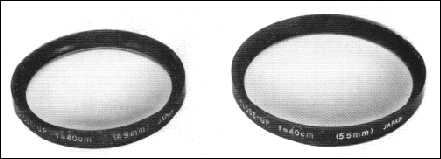
These two close-up lenses provide the most economical method of taking close-ups with the OM-1 standard lenses. The 55mm close-up lens is used with the standard 55mm F1.2 and the 49mm close-up lens with both the standard 50mm F1.4 and 50mm F1.8. With these close-up lenses, the minimum focusing distance of the standard lenses can be continuously varied from 45cm (17¾″) to 19cm (7¼″). At the minimum distance, a 12 × 8cm (4¾″ × 3 1/8″) area can be photographed full in the frame.
The 49mm close-up lens can also be used with the ZUIKO Macro 50mm.
How to Use Close-up Lenses
- These close-up lenses thread directly on the standard lenses without affecting the automatic diaphragm mechanism.
- Since depth of field is extremely shallow in close-up photography, the lens aperture should be stopped down between F8 and F11 to obtain maximum sharpness.
- Make it a rule to use a focusing stage, tripod and cable shutter release to eliminate vibrations that could degrade the image quality.
- For the best picture quality, light the subject area as evenly as possible.
OLYMPUS
OLYMPUS OPTICAL CO. LTD.
43-2 Hatagaya 2-chome, Shibuya-ku, Tokyo, Japan
Instruction leaflet (May 1979)
Alternatives
After Olympus shifted their emphasis away from the OM series, they introduced better-quality, achromatic close-up lenses for their fixed-lens iS-series SLRs. These close-up lenses were available in both 49 mm and 55 mm sizes. They were supplied with a plastic diffuser that clips onto a groove around the lens to soften the camera’s built-in flash and stop the front of the lens from partly blocking the flash.
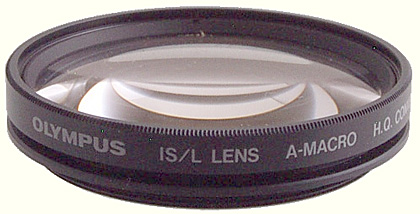
Olympus iS/L Lens A-Macro H.Q. Converter f=40cm
| iS/L Lens A-Macro H.Q. Converter f=40cm | iS/L Lens B-Macro H.Q. Converter f=40cm | iS/L Lens A-Life Size Macro H.Q. Converter f=13cm | |
|---|---|---|---|
| Focal length | 400 mm | 400 mm | 130 mm |
| Dioptre | + 2.5 | + 2.5 | + 8 |
| Lens elements | 2 | 2 | 3 |
| Lens groups | 1 | 2 | 3 |
| Lens coating | Multi | Multi | Multi |
| Length | 12 mm | 11 mm | 19 mm |
| Diameter | 56 mm | 64 mm | 60 mm |
| Rear filter thread | 49 × 0.75 mm | 55 × 0.75 mm | 49 × 0.75 mm |
| Front filter thread | None | None | None |
| Weight | 67 g | 105 g | 120 g |
| Case | Soft plastic pouch for lens and flash diffuser | Soft plastic pouch for lens and flash diffuser | Soft plastic pouch for lens and flash diffuser |
These achromatic iS series close-up lenses can be used on OM lenses with 49 mm and 55 mm filter threads, and produce significantly better results than the close-up lenses designated for the OM series.
These achromatic iS series close-up lenses are too big to fit into the recess on the Handy Copy Stand; the clamp is designed for items of approximately 51 mm diameter. They do not have a front filter thread, so it is not possible to use an adapter.
Sales Information File (24 rings)
Sales Information File (3 rings)
Send comments or questions to Alan Wood

Created 18th May 2001 — Updated 19th April 2026
Copyright © 2001–2026 Alan Wood