Close-up and macro photography for entomologists
Close-up lenses
Close-up lenses (also called supplementary lenses) screw into the filter mount on the front of the lens that is fitted to your camera, and bring the focusing range of the camera’s lens closer to the camera. The power of close-up lenses is normally specified in dioptres; higher numbers are more powerful. With the camera’s lens focused on infinity and a +1 dioptre close-up lens fitted, the maximum focusing distance becomes 1 metre, with a +2 it becomes 0.5 metres, and with a +4 it becomes 0.25 metres.
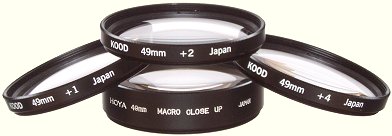
Close-up lenses for 35 mm cameras are commonly available with strengths of +1, +2, +3 and +4, but intermediate and higher strengths are also available. The lenses of digital cameras have shorter focal lengths than those for 35 mm cameras, and so they need stronger close-up lenses such as +7 and +10; these are often of too small a diameter and insufficient quality to be used on 35 mm cameras.
Close-up lenses are not usually corrected for optical aberrations, so you need to stop down the camera lens to at least f/8. The effects on image quality are greater with camera lenses of longer focal length, so better quality (and much more expensive) close-up lenses are needed for telephoto lenses and for roll-film cameras. Two-element achromatic close-up lenses are available: Nikon produce +1.5 and +2.9, Canon produce +2 and +4, and Hoya produce +10. Specially-matched close-up lenses are available for some macro lenses and medical lenses.
You can use two close-up lenses at a time, with the stronger one closer to the camera lens. The effect is additive, so a combination of a +1 and a +2 has the same power as a +3 close-up lens. Combining close-up lenses makes the drop in quality worse.
Close-up lenses are cheap, easy to use, cause no exposure problems, and do not darken the viewfinder, but they cannot match the quality of a macro lens. They are readily available, and are made by camera manufacturers and by independent companies.
The following tables show the subject area, working distance and magnification with the camera lens focused at infinity and at its closest distance. Focusing at closer distances gives greater magnification, shorter working distance and smaller subject area.
Close-up lenses with 50 mm lens on 35 mm camera (infinity focus)
| Dioptres | Focal length | Working distance | Subject size | Magnification |
|---|---|---|---|---|
| +1 | 1000 mm | 1000 mm | 720 × 480 mm | 0.05 |
| +2 | 500 mm | 500 mm | 360 × 240 mm | 0.1 |
| +2.5 | 400 mm | 400 mm | 288 × 192 mm | 0.125 |
| +3 | 333 mm | 333 mm | 240 × 160 mm | 0.15 |
| +4 | 250 mm | 250 mm | 180 × 120 mm | 0.2 |
| +10 | 100 mm | 100 mm | 72 × 48 mm | 0.5 |
Close-up lenses with 50 mm lens on 35 mm camera (closest focus)
| Dioptres | Focal length | Working distance | Subject size | Magnification |
|---|---|---|---|---|
| none | 360 mm | 237 × 158 mm | 0.15 | |
| +1 | 1000 mm | 264 mm | 176 × 117 mm | 0.21 |
| +2 | 500 mm | 210 mm | 140 × 93 mm | 0.26 |
| +2.5 | 400 mm | 184 mm | 125 × 83 mm | 0.29 |
| +3 | 333 mm | 172 mm | 117 × 78 mm | 0.31 |
| +4 | 250 mm | 146 mm | 99 × 66 mm | 0.36 |
| +10 | 100 mm | 74 mm | 53 × 35 mm | 0.69 |
Range of magnifications with 50 mm lens on 35 mm camera
| Dioptres | Magnification | ||||||
|---|---|---|---|---|---|---|---|
| 0.05 | 0.10 | 0.15 | 0.20 | 0.25 | 0.30 | 0.35 | |
| none | |||||||
| +1 | |||||||
| +2 | |||||||
| +3 | |||||||
| +4 | |||||||
Calculations for digital cameras must be based on the actual focal length of the camera lens, not the commonly-quoted 35 mm equivalent. Digital cameras do not all have the same chip size, so the subject area can only be approximate; the ones given were measured with a Kodak DC-4800.
Close-up lenses with 18 mm lens on digital camera
| Dioptres | Focal length | Working distance | Subject size | Magnification |
|---|---|---|---|---|
| +4 | 250 mm | 250 mm | 108 × 72 mm | 0.07 |
| +7 | 143 mm | 143 mm | 62 × 41 mm | 0.126 |
| +10 | 100 mm | 100 mm | 45 × 30 mm | 0.18 |
| +10 plus +7 | 59 mm | 59 mm | 27 × 18 mm | 0.305 |
Good points
- Small, light weight, easily portable
- Not expensive
- Don’t affect exposure
- Don’t darken SLR’s viewfinder or digital camera’s LCD screen
- Autofocus still works
Bad points
- Can’t be used at wide apertures
- Awkward to add, remove and combine in order to change magnification
- Definition not as good as a macro lens
- May need more than one for camera lenses with different filter sizes
See also Variable close-up lenses
Send comments or questions to Alan Wood


Created 27th December 1997 — Updated 10th April 2001
Copyright © 1987–2001 Alan Wood